Outsiderhood and social exclusion
The Painted BirdOutsiderhood and social exclusion in The Painted Bird are not merely feelings of isolation: they are social processes that turn difference into a basis for suspicion, rejection, and peril. The boy is marked by his appearance and speech before local villagers know his history, while the novel’s image of a painted bird makes exclusion visible as a group’s response to someone who no longer appears to belong.
The Mark of Difference
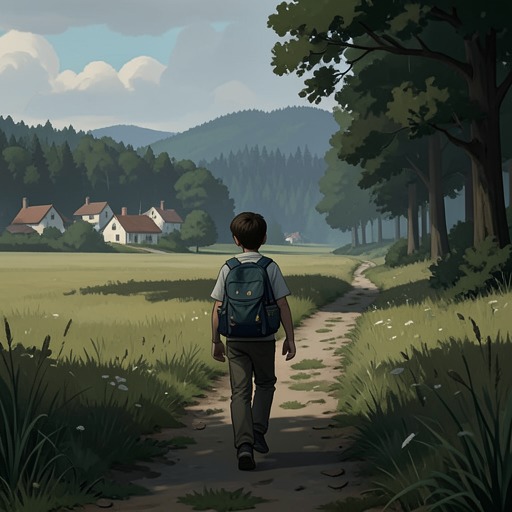
The novel’s introductory account establishes the boy’s vulnerability through several traits that set him apart from the peasants among whom he is sent during the first weeks of the Second World War. He has olive skin, dark hair, and dark eyes, unlike the fair-skinned, blond, blue- or gray-eyed villagers. He also speaks the language of the educated class, which local people can barely understand. These differences do not reveal his actual identity, but they invite others to assign one to him: he is taken for a Jewish or Roma child, and his presence is treated as a potential danger to anyone who shelters him under German occupation. The distinction between who he is and what others presume him to be is central to the novel’s account of exclusion. A child’s appearance and speech become social evidence in the eyes of people who have little knowledge of him and great reason to fear the consequences of association.
Exclusion in Everyday Encounters
The boy’s outsider status is enforced not only by official danger but through ordinary encounters that make a stranger conspicuous and unsafe. When a crowd gathers around him, its members speak in a dialect he cannot understand and regard him with suspicion; some hold dogs that strain toward him. The gathering turns uncertainty into collective intimidation. In the farm hut where he is taken, adults inspect his hair and repeatedly identify him as an outsider, while his attempt to explain himself in his own language becomes a source of amusement. The boy is not being judged on knowledge of his origins: his appearance and speech have already supplied the villagers with a category through which to interpret him.
The farm household makes this classification into a public spectacle. The owner brings visitors to look at the boy and orders him to perform actions that entertain them, while his makeshift clothing and vulnerability are part of the display. The visitors’ reactions follow a revealing pattern: some avert their eyes or spit, gestures that suggest fear of the very person they are treating as an object of curiosity. The scene shows exclusion operating through a mixture of mockery and superstition. The boy is made visible to the group, but that visibility does not grant him recognition or a hearing; it marks him as someone from whom the villagers must protect themselves.
Employment offers only conditional shelter. After reaching a village with a horse, the boy is questioned repeatedly about his past and asked whether he is a Jewish or Roma orphan. He insists that he is a Christian and an obedient worker, and the farmer finally takes him on as a farmhand. His acceptance depends less on resolving the suspicions about his identity than on making himself useful. The episode sets labor against belonging: he can be admitted to the farm’s work while remaining under scrutiny, and his grateful response underscores how narrow his alternatives are.
Even when the farmer takes him to weddings and celebrations, the boy’s difference remains something to be exhibited. He is required to recite poems and stories learned before the war from his mother and nurses. His quick, unfamiliar city speech strikes the guests as strange; they take it for a sign that something is wrong with him, then laugh at his animal tales and other stories. The performance briefly gives him an audience, but not an equal place among it. His language can entertain the villagers precisely because they treat it as a curiosity, so the apparent welcome reproduces the boundary between the local community and the child it has singled out.
Exclusion Beyond the Village
The boy’s precarious place is shaped from the outset by separation and loss. Sent away from his parents during the first weeks of the Second World War, he is meant to find temporary shelter, but his foster mother dies within two months. He is left to move from village to village, sometimes taken in and sometimes chased away. That repeated dependence makes exclusion more than a reaction to a single encounter: without family protection or a secure home, he must face each new community as a stranger whose safety rests on others’ decisions.
Work can provide a narrow foothold without ending that insecurity. Under Lekh, the boy sets snares in places the bird catcher cannot reach because he is small and light, including branches, dense plants, and waterlogged ground. The arrangement gives him a defined task within Lekh’s livelihood, which depends on selling birds and bartering them for food and other necessities. Yet the work also sharpens the novel’s recurring contrast between belonging and capture: the boy helps trap creatures whose beauty and songs are displayed to village buyers, while he himself remains vulnerable to other people’s judgments and choices.
A later search along the railway tracks exposes the lethal edge of the same social boundary. After villagers hear that trains carrying Jews have passed, they go looking beside the tracks and find a young, dark-haired boy who has been thrown from a train. The peasants fear his appearance and keep their distance; one woman takes his shoes, and the group leaves his body where a German patrol will find it. The scene presents a child’s vulnerability not as an exceptional accident but within a world where perceived identity can inhibit compassion and where the displaced are treated as objects to fear or use. It echoes the narrator’s own exposure without making the two children’s experiences identical.
Exclusion also recurs among children gathered after the war. At an orphanage of five hundred, the narrator sits among children affected by war and loss, but shared displacement does not produce trust. He cannot speak, and stronger boys interpret his silence as evidence that he is unintelligent; they insult and sometimes beat him. He fears both attack and the consequences of injuring someone in self-defense, since that could end his hope of returning to Gavrila. The setting thus complicates any simple division between a hostile outside and a safe refuge: institutional shelter gathers vulnerable children, yet fear and social labeling reproduce isolation within it.
The painted-bird image gives these episodes a larger pattern. The author recalls villagers painting captured birds and releasing them; their altered appearance leads their former flock to attack them. In the novel’s framing, the boy’s visible difference likewise becomes a sign by which a group marks someone as alien, even when that sign tells little about who he is. Readers later recognized this structure in other settings, including cities where color, language, or education could distinguish people cast as outsiders from a powerful majority. The image therefore connects the boy’s village encounters to a broader account of exclusion, while the book’s own reception repeats the metaphor: the author describes the novel as a painted bird driven from its flock by the rulers of his homeland, yet surviving the assaults.
Fiction, Identification, and the Outsider
The novel’s account of exclusion is shaped by a deliberate tension between particular historical danger and a setting freed from precise geography. The author drew on a childhood custom of painting captured birds and releasing them to their flocks, where their altered appearance made them targets; he joined that image to the example of Aristophanes’ symbolic birds and chose a timeless fictive present. The result allows the boy’s persecution to register as more than a documentary account of one place or period: the painted bird becomes a figure for any person whose visible difference is made to signify that they do not belong.
The book’s reception extended that pattern of identification beyond its fictional landscape. In the late 1960s, colleges and schools adopted it for modern-literature courses, and students and teachers sent the author essays about its characters and events. Readers who felt socially handicapped, including members of ethnic minorities, recognized in the boy’s struggle their own efforts to survive intellectually, emotionally, or physically. The author had resisted presenting himself as a spokesman for war survivors, regarding survival as an individual experience that entitled each survivor to speak only for himself. He also rejected using facts about his origins to authenticate the novel: unlike autobiography, he argued, fiction asks readers to enter a created role through their own experience and imagination. That distinction leaves the outsider’s story open to recognition without reducing it to a single life or prescribing one identity for its readers.